

Biodegradable Municipal Waste
Biodegradable Municipal Waste (BMW) is the biodegradable fraction of Municipal Solid Waste (historically this has been around 50% by weight of MSW).
Municipal Waste is waste from households and other sources that is similar nature/composition ie businesses, hospitals and schools.

Biodegradable Municipal Waste
Biodegradable waste is synonymous with Biogenic waste and typically comprises organic matter originating from plants, animals and microorganisms. This will include, for example, garden waste, paper, cardboard and food wastes.
Biodegradable Waste to Landfill Target - UK
BMW was historically important as the UK had legally binding EU targets to deliver set reductions of BMW waste to landfill.
Targets
The targets outlined below (and which the UK has meet), come from European Directive 1999/31/EC on the landfill of waste.
The amount of BMW to landfill as a target is measured against the 1995 baseline requiring:
- No greater than 75% of the 1995 baseline by 2010
- No greater than 50% of the 1995 baseline by 2013
- No greater than 35% of the 1995 baseline by 2020
Approach to Targets and Performance
These targets were originally addressed through individual targets on local authorities but they have now been lifted. The primary reliance moved to rely on the Landfill Tax and treatment systems under PFI funded schemes to deliver the objectives.
Biodegradable MSW to Landfill UK and Country Split
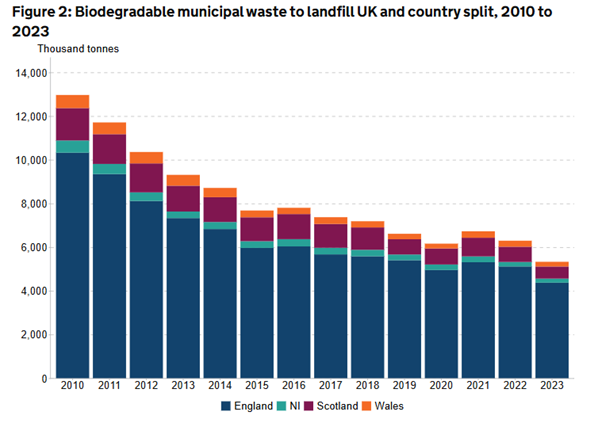
Graph extracted from Figure 2 of DEFRA Statisitcs[1]
Notes
- Tonnage has progressively dropped year on year, with 5.3 million tonnes sent to Landfill in 2023 (6.3 million in 2022) representing less than 20% of the 1995 baseline value[1]
- England was responsible for 81% of UK BMW to Landfill, accoutning for 4.4 million tonnes of the 5.3 million tonnes in 2023.