

Waste Electrical and Electronic Equipment (WEEE)
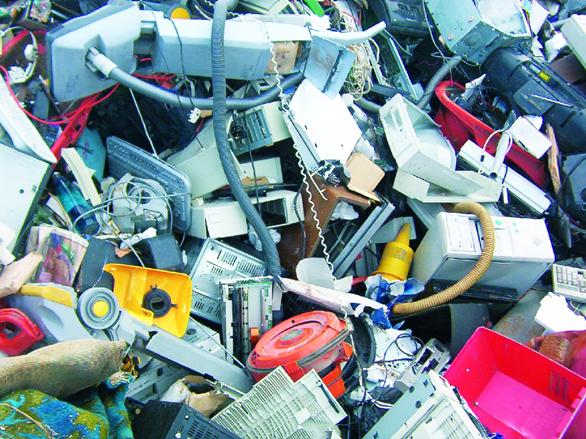
Waste Electrical and Electronic Equipment (WEEE), also known as E-waste, is end of life Electrical and Electronic Equipment (EEE), i.e. items that require electric currents or electromagnetic fields in order to operate.
WEEE was first introduced by the WEEE Directive in 2002 to address the environmental impacts of unwanted electrical and electronic equipment at end-of-life and disposal[1]. The objective of the Directive and its transposed legislation is to promote recycling and minimise waste by putting the emphasis for end-of-life treatment and recovery on the original producers or distributors of the items. WEEE is classed as either household (primarily EWC 20 01 35 and 20 01 36) or non-household (EWC 16 02 09* to 16).
Discarded Equipment Waste Arisings by Economic Classification (UK 2020)
Discard Equipment Waste Arisings
- 567.69 thousand tonnes (UK 2020 per above)
- 471.35 thousand tonnes (England 2020)
- 83.0% of tonnage was from England
Data source: [2]
Paper & Cardboard Waste Arisings (Waste Category and Economic Classification)
Commercial and Industrial* | UK 2020 | England 2020 | England 2022 |
|---|---|---|---|
Manufacturing | 0.01 | 995.00 | 1,088.31 |
Water Treatment | 0 | 0.63 | 0.83 |
Services | 1,745.11 | 3,197.81 | 3,262.64 |
Total | 1,750.70 | 4,193.44 | 4,351.83 |
% Total and % England | 99.7% | 61.3% |
Municipal Solid Waste* | UK 2020 | England 2020 | England 2022 |
|---|---|---|---|
Services | 3,701.11 | 3,197.81 | 3,262.64 |
Household | 2,868.63 | 2,636.18 | 2,288.91 |
Total | 6,569.74 | 5,833.99 | 5,551.54 |
% Total and % England | 85.1% | 85.4% |
All figures in thousand tonnes. Data source: [2] * See data limitations.
Background
Recycling of WEEE is a specialist part of the waste and recycling industry; it is a rapidly growing sub-sector due largely to the implementation of the original WEEE Directive.
WEEE generally contains a mixed variety of materials, potentially including hazardous ones (e.g. cadmium, arsenic or lead), making it problematic to manage and meaning the treatment methods for WEEE vary massively depending on the technology used and the relevant category[3]. It can include Persistent Organic Pollutants, or POPs, which require specific segregation and compliance with specific regulations[4].
The EA updated their public register of producers and approved exporters, authorised treatment facilities and producer compliance schemes regularly[5] and the tonnage collected on a quarterly basis.
The current national target for WEEE collection is 65% of the average of the previous three years placed on the market (or 85% of WEEE generated).
In the 2019-21 House of Commons Environmental Audit Committee Report[6] it identifies the UK as the second highest generator of E-waste per person in the world, after Norway, at 23.9kg per person.
Categories of WEEE
The regulations identify 15 broad categories of WEEE, including:
- Large household appliances e.g. fridges, cookers, microwaves, washing machines and dishwashers
- Small household appliances e.g. vacuum cleaners, irons, toasters and clocks
- IT and telecommunications equipment – e.g. personal computers, copying equipment, telephones and pocket calculators
- Consumer equipment e.g. radios, televisions, hi-fi equipment, camcorders ad musical instruments
- Lighting equipment e.g. straight and compact fluorescent tubes and high intensity discharge lamps
- Electrical and electronic tools – e.g. drills, saws and sewing machines, electric lawnmowers
- Toys, leisure and sports equipment e.g. electric trains, games consoles and running machines
- Medical devices e.g. (non infected) dialysis machines, analysers, medical freezers and cardiology equipment
- Monitoring and control equipment e .g. smoke detectors, thermostats and heating regulators
- Automatic dispensers e.g. hot drinks dispensers and money dispensers[6].
Tonnage Collected under the WEEE Regulations (2025)
The macro numbers above do not breakdown the component elements of WEEE, but the following table breaks down the data for the UK for the most recent year (January 2025 to December 2025) for Household and Non-household WEEE[7].
Category Name | Household WEEE collected from a DCF[8](tonnes) | Household WEEE returned under regulation 43[9] (tonnes) | Household WEEE returned under regulation 50 [10](tonnes) | Total separately collected Household WEEE[12](tonnes) | Total Non-household WEEE (tonnes) | Total WEEE (tonnes) |
|---|---|---|---|---|---|---|
Large Household Appliances | 60,859 | 95,608 | 18,734 | 175,200 | 1,543 | 176,743 |
Small Household Appliances | 32,225 | 643 | 4,540 | 36,907 | 35 | 36,943 |
IT and Telcomms Equipment | 28,034 | 1,532 | 10,444 | 40,010 | 802 | 40,812 |
Consumer Equipment | 20,026 | 473 | 1,989 | 22,488 | 2 | 22,490 |
Lighting Equipment | 5,430 | 81 | 733 | 6,244 | 1,576 | 7,820 |
Electrical and Electronic Tools | 24,943 | 346 | 2,379 | 27,668 | 133 | 27,801 |
Toys Leisure and Sports | 5,333 | 119 | 752 | 6,203 | 0 | 6,203 |
Medical Devices | 0 | 2 | 43 | 45 | 225 | 270 |
Monitoring and Control Instruments | 1,007 | 15 | 203 | 1,226 | 63 | 1,289 |
Automatic Dispensers | 0 | 1 | 32 | 33 | 90 | 123 |
Display Equipment | 38,773 | 2,694 | 4,798 | 46,265 | 8 | 46,273 |
Cooling Appliances Containing Refrigerants | 78,232 | 49,125 | 14,734 | 142,090 | 3,283 | 145,373 |
Gas Discharge Lamps and LED Light Sources | 793 | 495 | 2,162 | 3,450 | 3 | 3,453 |
Photovoltaic Panels | 0 | 0 | 0 | 0 | 0 | 0 |
Total | 295,963 | 151,141 | 62,897 | 509,501 | 7,764 | 517,264 |
Local Authority Waste
The Top 10 Authorities removing WEEE. WEEE includes the following sub groups of material: WEEE - Fridges & Freezers, WEEE - Small Domestic App, WEEE - Large Domestic App, WEEE - Flourescent tubes and other light bulbs, WEEE - TVs & Monitors
| FY | AUTHORITY | OPERATOR | ADDRESS | TONNES |
|---|---|---|---|---|
| 24/25 | Merseyside WDA (MBC) | S Norton & Co Ltd | Bankfield House, Bankfield Mill, Regent Road, Liverpool, Merseyside | 19,261 |
| 24/25 | Merseyside WDA (MBC) | S Norton & Co Ltd | Bankfield House, Bankfield Mill, Regent Road, Liverpool, Merseyside | 19,261 |
| 24/25 | Stockport MBC | SUEZ Recycling and Recovery UK Ltd | Longley Lane, Sharston, Manchester | 10,799 |
| 24/25 | West Sussex County Council | M D J Light Bros ( Scrap Processors ) Ltd | Greystone Quarry, Southerham, Lewes, East Sussex | 9,625 |
| 24/25 | West Sussex County Council | M D J Light Bros ( Scrap Processors ) Ltd | Greystone Quarry, Southerham, Lewes, East Sussex | 9,625 |
| 24/25 | West Sussex County Council | M D J Light Bros ( Scrap Processors ) Ltd | Greystone Quarry, Southerham, Lewes, East Sussex | 9,625 |
| 24/25 | West Sussex County Council | M D J Light Bros ( Scrap Processors ) Ltd | Greystone Quarry, Southerham, Lewes, East Sussex | 9,625 |
| 24/25 | Cornwall | Henry And William Henry Orchard | Burnt House Garage, Dobwalls, Liskeard, Cornwall | 9,158 |
| 24/25 | Greater Manchester WDA (MBC) | Other/Exempt | Global Ardour Recycling Limited; Birch St, Bury, Greater Manchester | 8,482 |
| 24/25 | Devon County Council | Sims Group Uk Ltd | 7 Christow Road, Marsh Barton Ind Est, Exeter, Devon | 8,062 |
References:
- DEFRA and OPSS Guidance - Regulations: WEEE
- UK Statistics on Waste
- HSE Waste Processing Guidance
- POP Regulations 2019
- WEEE public registers
- Electronic Waste and the Circular Economy (House of Commons Environmental Audit Committee 2019-21)
- WEEE in the UK: Reports Managed by the EA
- This figure includes household WEEE from Designated Collection Facilities (DCFs) that has been collected by Producer Compliance Schemes, and household WEEE that DCFs have cleared themselves
- This figure includes household WEEE returned by distributors to Producer Compliance Schemes
- This figure includes household WEEE collected through a collection system a Producer Compliance Scheme operates itself
- This figure is the amount of WEEE Producer Compliance Schemes have reported as being delivered to Approved Authorised Treatment Facilities and Approved Exporters on their behalf