

Local Authority Collection Systems
The complexity and variety of approaches to the collection of household waste has progressively increased over the last 30 years and is set to change further in England for many householders with the introduction of Simpler Recycling from April 2026.
The current system varies greatly across the UK, reflecting historical decisions by different local authorities and devolved administrations trying to delivery higher recycling rates and keep costs of collection under control.
Whilst Wales has preferred/manadated collection system(s), the large majority of the UK does not. From April 2026 however local authorities in England are required to introduce a standardised, consistent recycling system for all households and businesses, including mandatory weekly food waste collections.
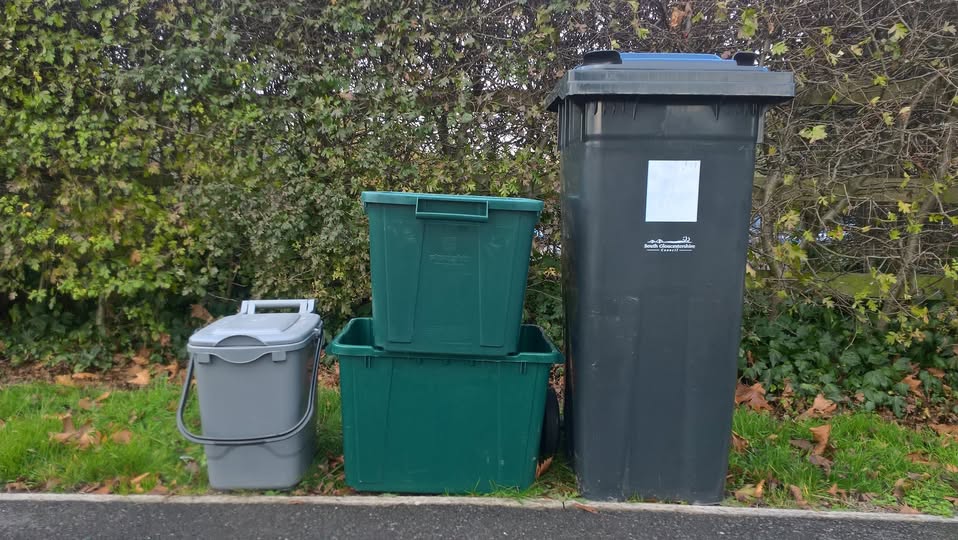
Main Elements of Collection System
The main elements of the collection service delivered by local authorities to householders are:
- 'Black Bag'/Residual Waste
- Dry Recyclables
- Food
- Green Waste
- Healthcare Waste
- Bulky Waste
Main Variables in System Design
The way the collection system is designed considers the following key variables, with each aspect impacting the other:
- Frequency of collection
- Approach to Dry Recyclables Collection
- Approach to food waste (separate collection or combined with garden waste)
- Size and type of bins/containers
The design also fundamentally impacts the choice of lorry that then needs to be used to collect the materials.
Philosophical Approach to Dry Recyclables Collection
There are three main approaches to the collection of dry recyclables:
- The 'all in one bin' or 'comingled' solution, for later sorting at a MRF (Materials Recycling Facility)
- The 'dual material' approach or 'twin stream' solution that is similar in may ways to the comingled system, but generally keeps paper & card separate
- The 'sorting into the lorry' often termed 'kerbside sort' solution or 'multi-sort' solution, with bulking at the waste transfer station/depot and limited sorting required.
This picture has become more complex with the requirements of Simpler Recycling to collect more materials and to keep paper & card (fibre) separate unless TEEP (technically, environmentally and economically practicable) allows otherwise.
Approach to Organics Waste Collection
There are three main approaches to the collection of organic waste:
- Separate green waste, for later treatment via windrow composting
- Separate food waste, for later treatment primarily via Anaerobic Digestion (AD)
- Mixed food and green waste, for later treatment primarily via in vessel composting (IVC)
This picture has become more complex with some councils charging for the green/garden waste collections, and the requirement under Simpler Recycling to separately collect food waste unless TEEP allows otherwise.
Service Structures - Main Options for Collection System Design Proposed by WRAP
The picture below is a summary of the preferred 'total system' designed by WRAP[1] as part of the precursor to Simpler Recycling, when there was to be a manadatory choice of one of the three collection systems, (which did not occur).
Conceptually it offers a certain capacity of bin, and as many residual waste bins are 180 litres in size it, by default, is designed for fortnightly residual waste collection and weekly food and dry recyclables collection.
This approach uses 'nudge theory' to change householder behaviour by providing more frequent and more volume for recyclables and less frequent and less volume for residual waste.
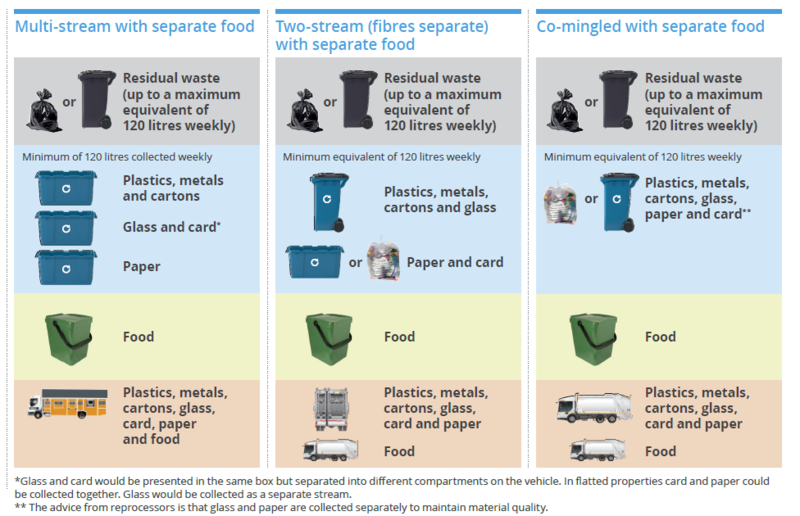
The choice of lorry at the bottom of the picture shows a Kerbside Collection Lorry for the Kerbside/Multi-Stream system, and Refuse Collection Vehicles for the other two systems (split body for the twin stream approach) with separate food pods.
Ongoing Differences
The three options in the picture to the left will differ accross the UK for a number of key reasons:
- The philosophy towards the frequency of residual waste collection (weekly/fornightly/three weekly/monthly)
- The philosophy towards dry recyclables collection and the configuration of MRFs to receive the materials
- The housing stock in a local authority area (multiple occupancy and flats bring their own challenges as do rural areas with limited access)
- The approach to green waste collection and charging (not captured in the picture, but set out above)
- The historical approaches that make change so significant that a local authority argues under TEEP that they should continue with existing approaches
Charging for Services
The collection of waste and recyclables from residents is a legal requirement under the Environmental Protection Act 1990. A Local Authority therefore cannot charge their residents for the use of this service provided the waste and recyclables fit within the containers provided by their Waste Collection Authority and/or weigh less than 25kg.
There are some exceptions to this arrangement but the current Regulations stipulate when a Waste Collection Authority is able to charge its residents for the collection and/or disposal of household waste. These exceptions are:
- any item of waste which exceeds 25kg in weight (often referred to as a 'Bulky Waste Collection').
- any item which does not fit into the container provided by the Waste Collection Authority
- the collection of clinical waste; and
- the collection of Green Waste/Garden Waste
As a result bulky waste and clinical waste collections are generally made via specific lorries as a result of a specific request(s) by householders (lower grade healthcare waste, however, is normally disposed of within the residual waste stream).
Future Changes - Flexible Plastics
Simpler Recycling introduces the requirement to collect flexible film from 2027 - which local authorities will start to build into collection systems in the near future. It will be able to be delivered in one of three ways, as set out in the FlexCollect Report[2] :
- Loose in comingled collections where the MRF has been configured to be able to remove it
- A survival bag (40 micron thick) in an existing bin/container (aligned with twin-stream systems)
- A survival bag (18 to 20 microns thick) in source seggregated/kerbside collection systems
Future Changes - UK ETS (UK Emissions Trading Scheme)
The introduction of the UK ETS from 2029 onwards will have ramifications for the cost of residual waste disposal for local authorities.
With the current MRV (monitoring, reporting and verification) period still not delivering clarity on the way the UK ETS will be implimented there is little in the way of system change planned at the current time.
Future plans might consider targetting some further materials for separate collection or further treating residual waste after collection to reduce the cost ramifications.