

Commercial Waste Collection Systems
Over the past 30 years, the collection of commercial waste has become increasingly complex, with a growing variety of service models and container systems. From April 2025, businesses in England face further changes under Simpler Recycling and businesses in Wales under Workplace Recycling, which introduce new requirements for how commercial waste must be separated and collected..
The approach to business waste varies according to how similar it is to household waste, the tonnage of materials (which vary according to size and type of business ), any material-speciifc requirements, and the space the business has to store and 'bulk up' material prior to being transported off site for treatment.
Collection systems at the smaller-end of the scale most closely resemble household collection systems and can be delivered by the local authority or their contractor. At the larger-end of the scale specialist waste companies offer comprehensive services as a 'one-stop-shop' for businesses and/or solutions for particular wastes.
Approach by Scale
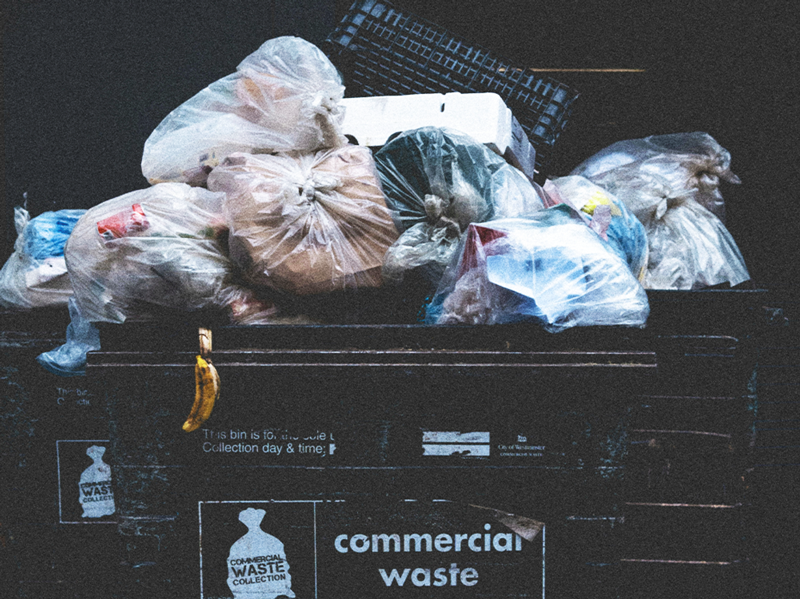
- Bag based Systems: small volumes of waste in pre-paid bags, sometimes with separatley bundled card, this application is often for smaller high street retailers and 'micro' businesses and is often collected in city/town centres overnight. These will generally be micro-businesses and be outside Simpler Recycling and Workplace recycling obligations
- Wheeled Bin Systems: moderate to higher volumes of waste, typically in 1100 litre bins. Dry recyclables are typically comingled with card but cardboard is increasingly bundled or in separate bins to comply with legislation. Food bins are now added where the tonnage warrants/legally requires separation, typically for pubs clubs and restaurants. Larger businesses typically have more bins and/or more frequent collections/'lifts' that can be multiple times a week
- Skip-Based Systems: larger to higher volumes of waste, which are compactable, and where there is space for either the REL or FEL skips - the approach can be broadly the same as wheeled bin systems and can sometimes be used in combination with wheeled bins as part of a comprehensive service for all materials
- On-Site Systems: large volumes of waste in a single location, which combines different bins for different uses. It can include multiple wheeled bin systems and can include compactors for paper & card and residual waste. Typically large multi-discplinary businesses, hospitals, hotels, shopping centres and hospitality event-based businesses (the latter with large volumes of separate glass and food wastes)
Core Materials
Legally the same separation and collection requirements apply to the range and type of materials as household waste where the wastes are similar in nature, and include:
- 'Black Bag'/Residual Waste
- Dry Recyclables (including paper & card, plastics, metal and glass)
- Food Waste
In Wales business are also required to separately collect small WEEE.
Collection systems are generally focused on mobile compaction in RCV, FEL and REL lorries with separate PODs for food waste where the volume is low.
Niche/Business-Specific Materials
Specific businesses will generate waste streams that require particular collection solutions. They include:
- Washroom Waste (Healthcare Wastes)
- Clinical Wastes
- WEEE
- Chemical Wastes
- Confidential Wastes
- Bulky Wastes
Some of these materials have dedicated bins (for example yellow coloured wheeled bins for Clinical and Healthcare Wastes) where the bins are collected and returned after emptying at an appropriate treatment site.
Implications of Packaging
Those companies falling into the Packaging Extended Producer Responsibility legal framework may chose to capture their packaging waste and 'internalise' their recycled material in a way that gives better oversight and control over the packaging materials handled.
This could especially be the case, for example, for supermarkets that consolidate cardboard packaging at distribution centres for onward trading and generation of PRNs. This can influence the collection systems (for example using reverse logistics; standard delivery lorries return cardboard to a distribution centre) and change the way the business contracts with waste collection businesses.
Implications of UK ETS (UK Emissions Trading Scheme)
The introduction of the UK ETS from 2029 onwards will have ramifications for the cost of residual waste disposal for businesses, passed on by the collection companies to businesses.
With the current MRV (monitoring, reporting and verification) period still not delivering clarity on the way the UK ETS will be implimented there is little in the way of system change planned at the current time.
Future plans might consider targetting some further materials for separate collection or further treating residual waste after collection to reduce the cost ramifications.
References:
None